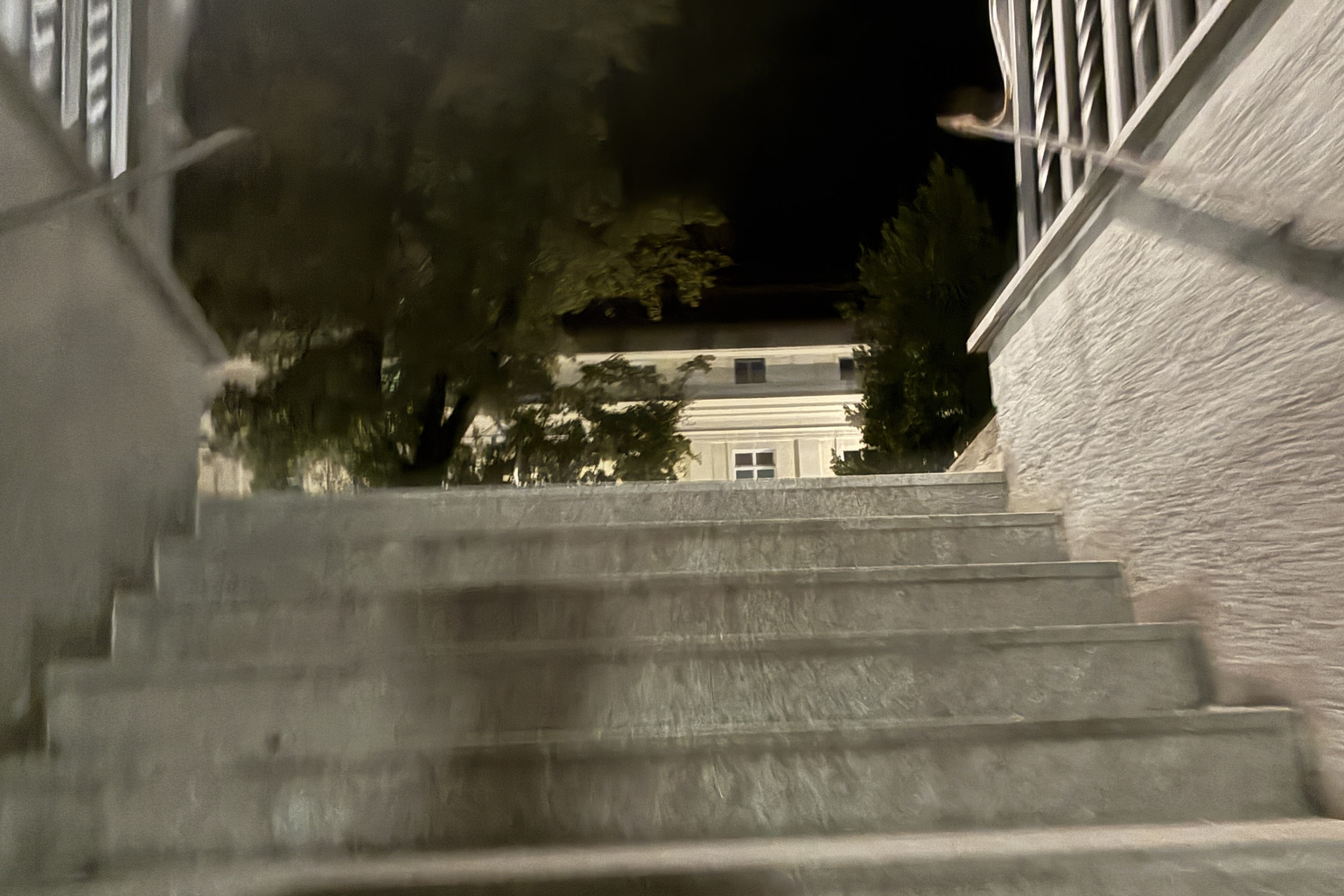
I’m building an AI that writes articles about places based on photos taken around a city.
The process is simple in principle: first, it observes the photo. Then it turns what it notices into questions, researches those questions, and uses only information that can actually be verified.
At the observation stage, I tried a small experiment.
I showed the exact same street photo to seven different “editors”: an editor for a history magazine, an architecture magazine, a magazine about strange and overlooked things, a magazine about everyday objects, a counseling magazine, a philosophy magazine, and one editor with no particular identity at all.
Underneath, they were all the same AI.
There was one rule, though: their identities were not allowed to change the way they spoke.
If you tell an AI to “write like a philosopher,” it quickly starts producing philosophical-sounding prose. The problem is that it also starts reading meanings into things that may not actually be there.
So I gave every editor the same constraints.
Write only about what is visibly present.
Do not discuss people, weather, seasons, or cars.
Do not give opinions or evaluations.
The only thing I changed was what they were told to pay attention to.
The philosophy editor was asked to look for “signs of different layers of time.”
The counseling editor was asked to consider “how the human body might experience or move through this space.”
That single sentence was the only difference.
And yet, looking at the same street, they noticed different things.
Philosophy editor: Near the center of the road, irregular seams in the asphalt form a line that suggests something may once have been buried or repaired beneath it.
Counseling editor: At the end of the street, the front wall of a building faces directly toward you, causing the line of sight to stop there.
Change the “eye,” and the things that get noticed change with it.
So far, that was exactly what I wanted.
Next, I measured how unusual each editor’s observations were by looking at how often they noticed something that none of the others had mentioned.
The philosophy editor was the most distinctive. About 70% of its observations were unique.
Then I took those observations, turned them into research questions, and searched for information that could become material for an article.
That was where the result flipped.
None of the material generated from the philosophy editor’s observations could be independently verified.
Meanwhile, the counseling editor, which had seemed much less distinctive, produced observations whose related research could all be verified.
The reason was fairly simple.
The philosophy editor focused on things like seams in pavement, thresholds, traces of sealed-up windows, and boundary stones.
They were genuinely interesting. But they were also the kinds of things that nobody had documented.
The counseling editor noticed things like the orientation of benches, the width of alleyways, and roofs designed to create shade.
These were more likely to have been deliberately designed or installed by someone, which meant there was also a better chance that records existed explaining why they were there.
So having a more unusual way of seeing did not necessarily mean finding better material for an article.
But that was not the most interesting part to me.
I had not changed the model.
I had not changed the training data.
I had changed only one short line of text describing what to look at.
That alone changed what the AI noticed, which changed the questions it asked, which in turn changed the information it eventually reached.
Giving an LLM an identity may not simply be a matter of making it “play a character.”
It may be a way of changing what it extracts from the same world.
And these “eyes” are still being created with extremely crude instructions—sometimes just a single sentence.
That makes me think there are still many ways of using LLMs that we have not even learned how to describe yet.