In March, at SXSW in Austin, we showed timespace ZINE to people for the first time. Walk through a city, notice something, take one photo. A few seconds later, a small magazine about that place appears. The reaction was good.
But since we got back, one question has stayed with me.
With AI, an article about Linz — where we're headed next — is easy to make. "The history of Linz." "The Danube." "The steel industry." Search for any of it and you'll find plenty. Hand it to an LLM and you'll get something reasonably accurate, reasonably readable. But that's an article about Linz. It isn't an article that could only have come from this moment, this place, this one photograph.
That's what we want to bring to Ars Electronica in September.
A photograph isn't material. It's a question.
In the first version, our local search was mostly location-driven. Find where someone is standing, pull up whatever's tied to that spot. But that means two people standing at the same intersection get nearly the same information back.
That's not how a city actually works. Standing in the same place, one person notices a building. Another notices a sign. Someone else can't stop looking at a crack in a wall. What a person picks up from a city was never just GPS coordinates.
So in the current version, the photograph itself is the starting point for the search.
It isn't only the cover of the article. It becomes the question that connects whatever someone happens to be paying attention to, right then, to everything the city knows about that spot.
The story of a yellow wall
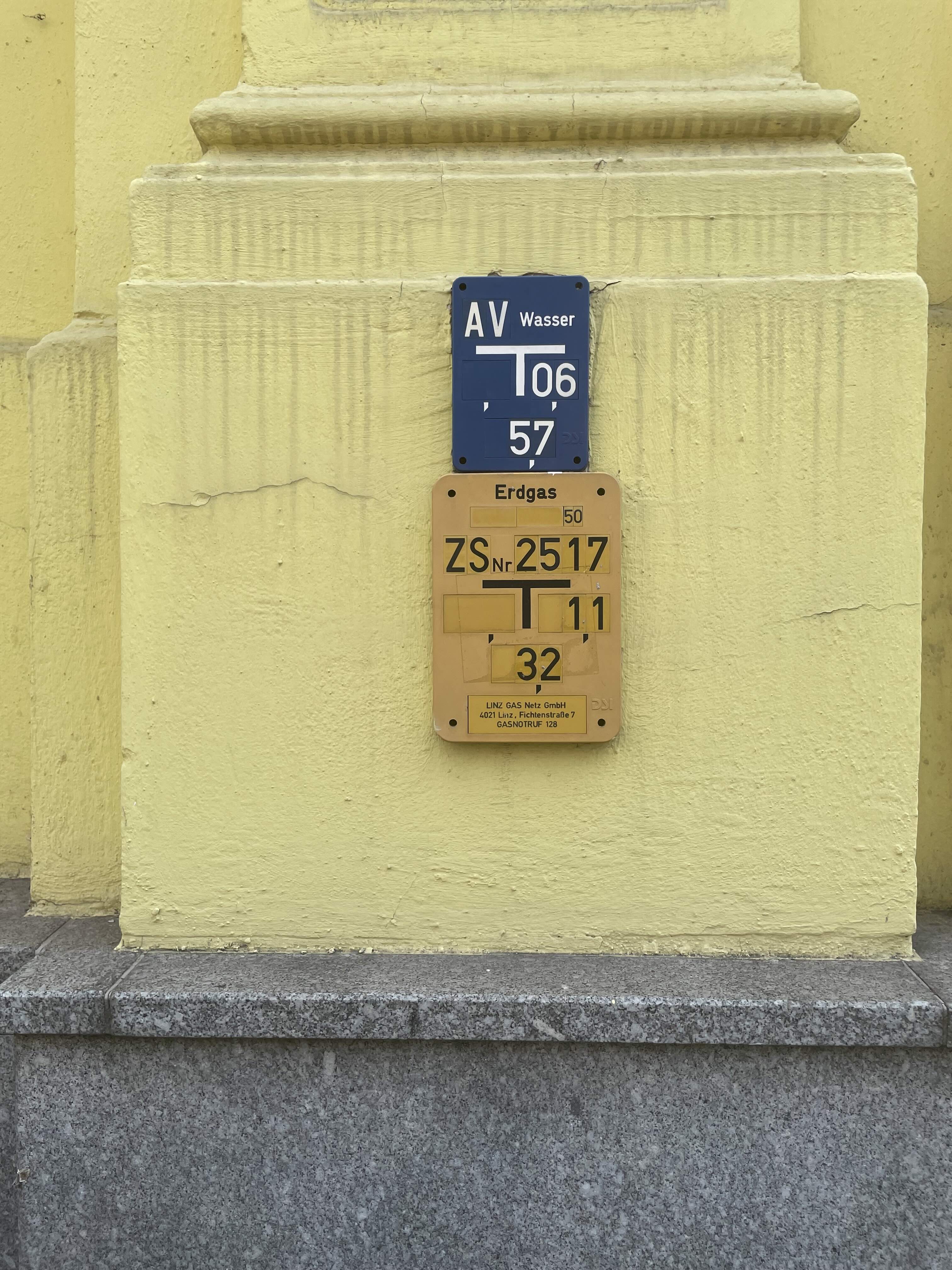
There's an unremarkable photo we took in Linz. A yellow wall, two small metal plates. Not a landmark. Most people would walk right past it.
But look closer, and the lower plate reads "Erdgas" — natural gas. Linz switched from town gas to natural gas in 1971. So this word, at minimum, belongs to the time since then.
There's a company name stamped in small letters too: LINZ GAS Netz GmbH. That name doesn't exist anymore. In 2018, it merged with the electricity network company to become today's LINZ NETZ GmbH.
But right next to it, "GASNOTRUF 128" — the gas emergency number — is still active. The company's name became history. The phone number didn't.
Two things sit on the same piece of metal: one that's gone, one that's still alive.
And behind it all, the yellow wall itself. Austria has a historical color culture known as "Schönbrunner-Gelb." This is exactly where AI is tempted to get clever. This wall, too, carries on the Habsburg tradition of imperial yellow. It would read beautifully. It's probably wrong.
Look into it, and the color turns out not to be a single defined code, and the famous story — that Joseph II ordered every imperial building painted this shade — has no confirmed source behind it either.
So whether this wall belongs to that history: we don't know.
What you don't know, you can't search for
None of the individual pieces in that photo — the standard, the company name, the number, the color's history — are unknown to AI on their own. But no one searches for all four at once, because no one knows, before they look, that they're connected at all.
You can't search for what you don't know exists.
But you can see it. You can photograph it.
So we make the photograph the starting point of the search. What we've spent the last six months building isn't the app itself — it's the precision underneath it, in how a city gets read.
That's our R&D, on the way from Austin to Linz.