
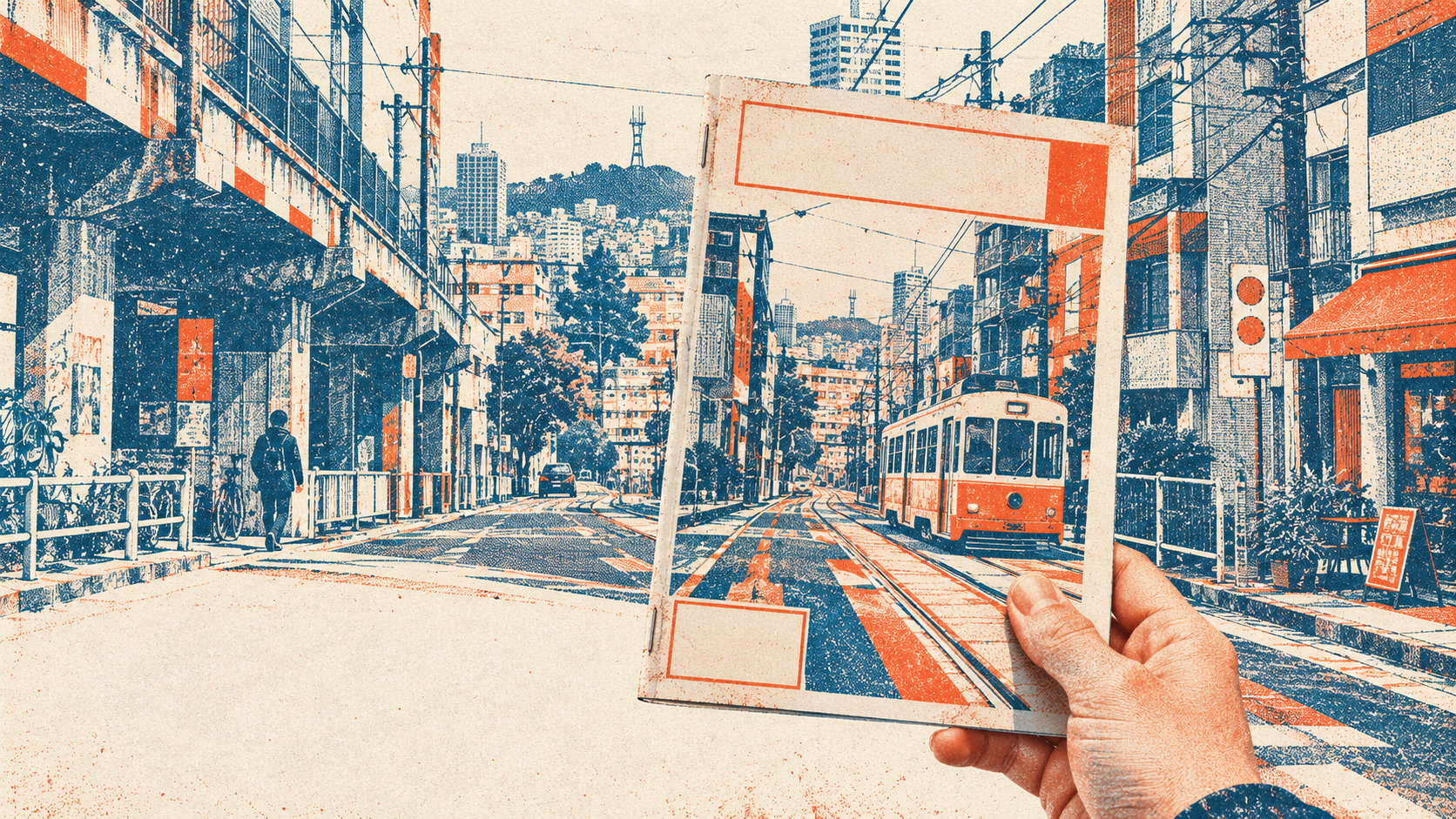
01 — THE HILL
I watched The Last Black Man in San Francisco.
There’s a scene where Jimmie, the main character, rides his skateboard down one of those San Francisco hills.
The moment I saw it, the air from the years I spent in SF suddenly came back into my body.
The way the city changes completely every time you go up or down a hill.
The cold wind — basically, it’s always cold.
That pale evening light — somehow San Francisco is usually way too bright.
The wooden walls of old Victorian houses, with those strangely charming colonial details.
The sound of buses passing by.
And then the ocean suddenly appearing beyond the top of a hill. It still surprises me every time.
A beautiful city, but always slightly broken.
02 — A HOUSE THAT ISN’T HIS
Jimmie keeps returning to a Victorian house he believes his grandfather built, even though he no longer lives there.
He fixes the walls. Paints them. Takes care of the garden.
It isn’t even his house.
It’s ridiculous. Almost foolish.
And yet I completely understand it.
Once you’ve lived in San Francisco, even places that never belonged to you somehow become part of your own memory.
Even right in the middle of Market Street, buildings from the early twentieth century are still alive and functioning. Different eras exist on top of one another. Memories get mixed together.
03 — BEFORE THE LOGOS
I lived there just before tech-company logos began to cover everything.
There were still artists, musicians, designers, and all kinds of chaotic people whose jobs were impossible to explain, moving around the city and making things.
Mission Pie. Mission Bicycle. Revolution Cafe.
Places that carried that particular smell of San Francisco.
They’re gone now.
What I loved about this movie is that it doesn’t romanticize that past.
And maybe that’s exactly why it smells so strongly of San Francisco — not some nostalgic version of it, but the city as it exists now, with everything that came before still underneath it.
Director Joe Talbot and Jimmie Fails grew up in San Francisco together.
This isn’t a San Francisco reconstructed by someone who came in, researched the city, and tried to reproduce it.
It was made by people who watched their own city change.
That makes an enormous difference.
04 — BACK TO SAN FRANCISCO, OCTOBER 8–18
I’m going back to SF for TechCrunch Disrupt.
And this time I’m bringing about 200 copies of SF ZINE with me.
The material comes from photographs I took while living there, along with my own memories of the city.
Our ZINE team in Kyoto dug through all of that together, reassembled it, and turned it into something new.
There’s a particular feeling you get in San Francisco when you turn onto an unfamiliar street and somehow a house you’ve never seen before feels nostalgic.
Or when the evening light alone makes you want to stay in a neighborhood another hour.
The food is great, of course. But beyond that, SF has these strange gathering places, blocks, corners, and little pockets that don’t really exist anywhere else.
That’s what I want to collect.
05 — LAYERS
Watching The Last Black Man in San Francisco made me realize that this is probably where SF ZINE needs to begin.
A city isn’t a collection of landmarks.
It’s the memories of the people who lived there.
The shops that disappeared.
The people who were pushed out.
The buildings that somehow survived.
The dreams somebody had there thirty or fifty years ago.
A city is made from all of those layers existing at once.
06 — 200 COPIES
San Francisco doesn’t have The New Yorker.
At least, it doesn’t have the kind of cultural magazine about San Francisco that I personally want to read.
So that’s one of the ambitions behind SF ZINE.
For now, we’ll start with 200 copies.
Jimmie kept showing up to repaint a house that wasn’t even his.
I’m going back to do something similar — just a little bit — to a city I used to call home.

