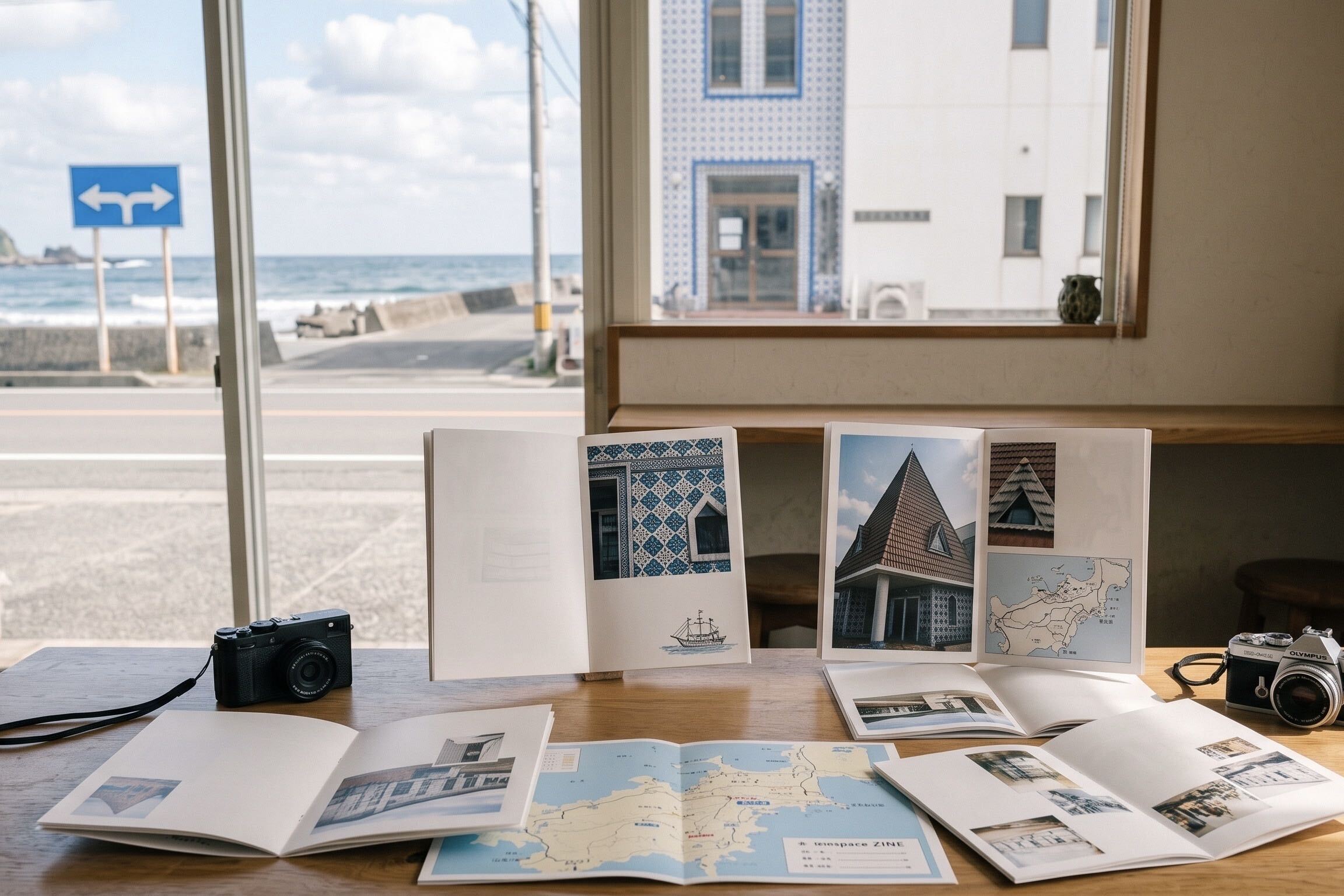
On August 4, a ZINE was created in Kushimoto, Wakayama.
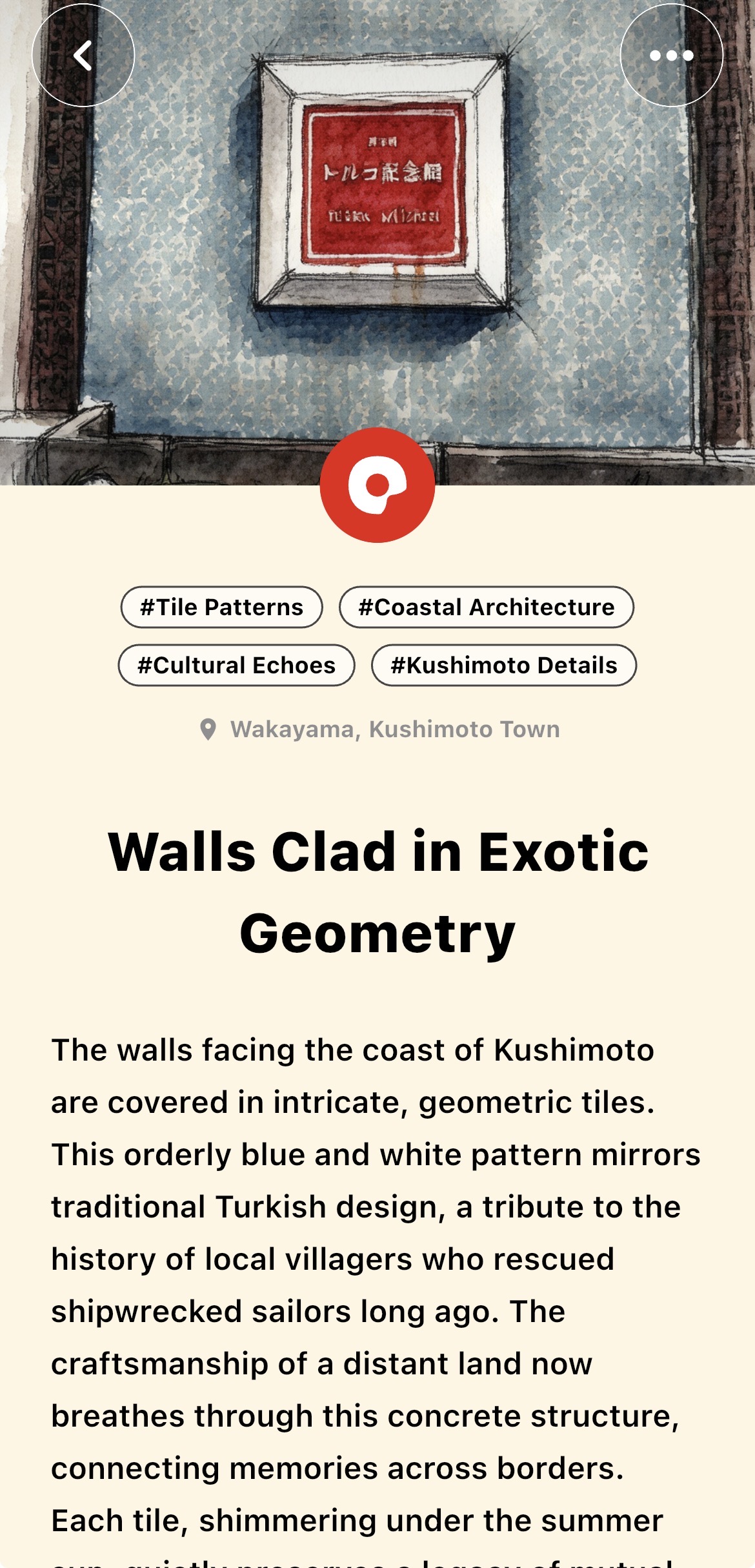
The article focused on the geometric patterns covering the walls of a building.
It read Turkish motifs in the blue-and-white tiles and connected them to the local history of people rescuing shipwrecked sailors.
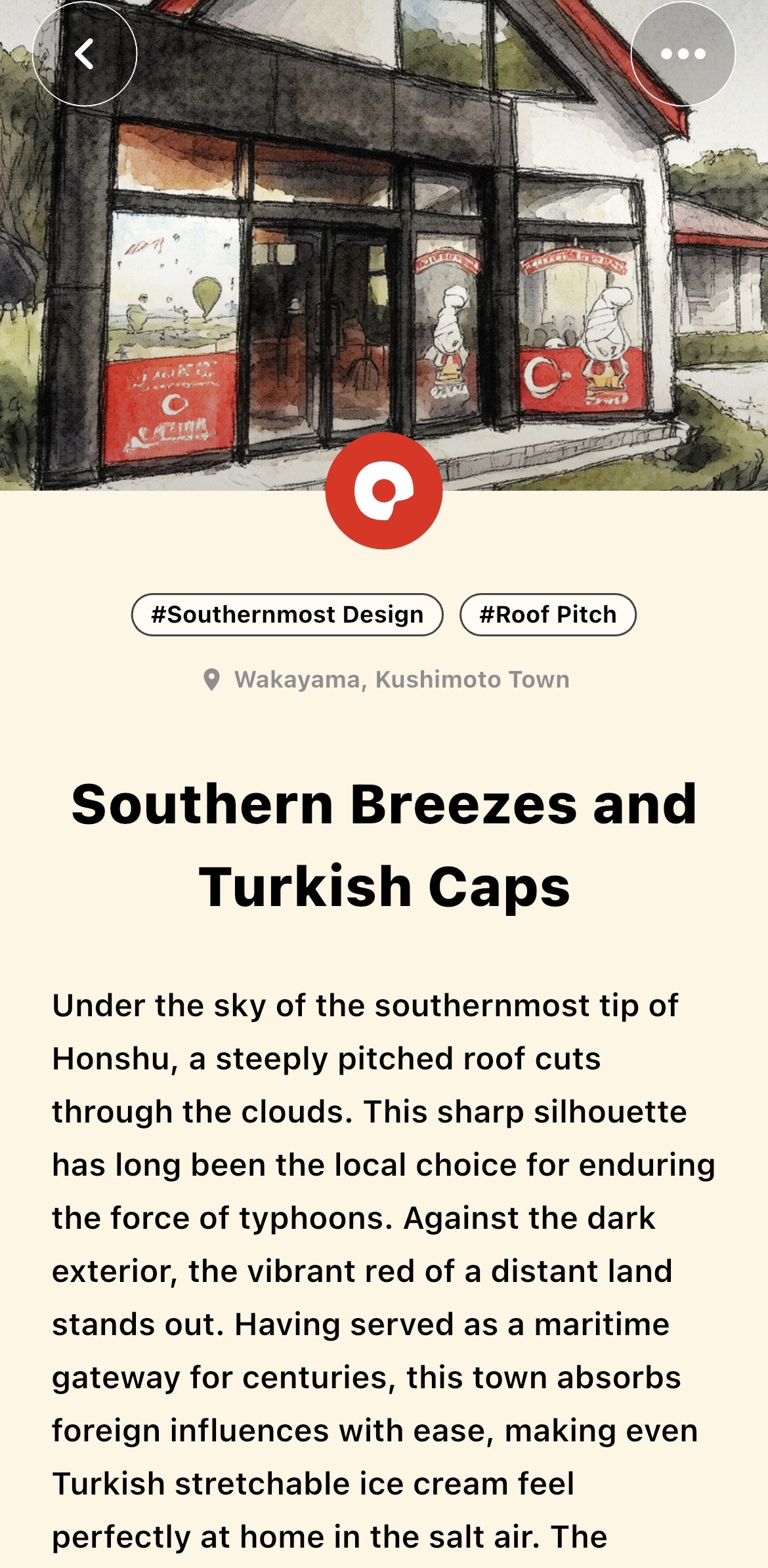
Seventeen days later, someone else photographed the same building.
This time, the article focused on its steeply pitched roof.
It moved from architecture designed to withstand typhoons to the history of a port town that had long welcomed influences from abroad.
Both ZINEs displayed the same location: Kushimoto, Wakayama.
On a map, they are the same place. But the two people found different things there.
A map is an excellent interface for answering the question, “Where is it?”
It gives places coordinates and names, turning the complexity of a city into something we can understand at a glance.
timespace ZINE also uses location data and structured information about places. We are not rejecting maps. Early concepts included a map screen, and people still ask us to build one.
Even so, the current experience is not centered on a map. Its core consists of Scan, where people take photographs; Commons, where ZINEs from around the world flow; and Shelf, where people keep the ZINEs they want to remember.
When a map becomes the center of a product, a place first becomes a point of interest.
The article then tends to become an explanation of that point.
timespace ZINE sends the photograph itself to the AI, not just the location. Instead of creating a general travel guide from a place name, it makes what the person chose to photograph the center of the article.
Location data anchors the article in fact.
But it does not decide what to look at.
Even within the same building, one person may notice a wall while another notices the roof. AI can connect that small spark of attention to histories and cultures that one person alone might never have connected.
What we want to create is an encounter with something you did not know you wanted to know.
If a map reduces a place to a single point,
a ranking reduces many perspectives to a single order.
There is no popularity ranking in the timespace ZINE Commons. ZINEs currently appear chronologically, with the newest first.
The two ZINEs from Kushimoto cannot be ranked against each other.
If one were placed above the other as the “better” representation of Kushimoto, the other perspective would become harder to see. Eventually, people would start photographing what they expected to be rewarded for.
Rankings do more than change display order.
They also make future perspectives more alike.
That is why timespace ZINE does not display public Like counts.
Instead, people can place a ZINE that interests them on their own Shelf.
A Like adds a number to the work.
A Shelf brings the work home.
I want to read this again.
I do not want to lose it.
I feel as though I, too, have touched the time accumulated in that place.Place on My Shelf is designed to preserve that feeling.
We could build a map.
We could sort ZINEs by popularity.
For now, however, we are focusing on what matters most.
Turning the world into a magazine.
Take a photograph, and an article emerges from that place.
Different articles can emerge from the same place, each remaining without any one of them being chosen as the single correct version.