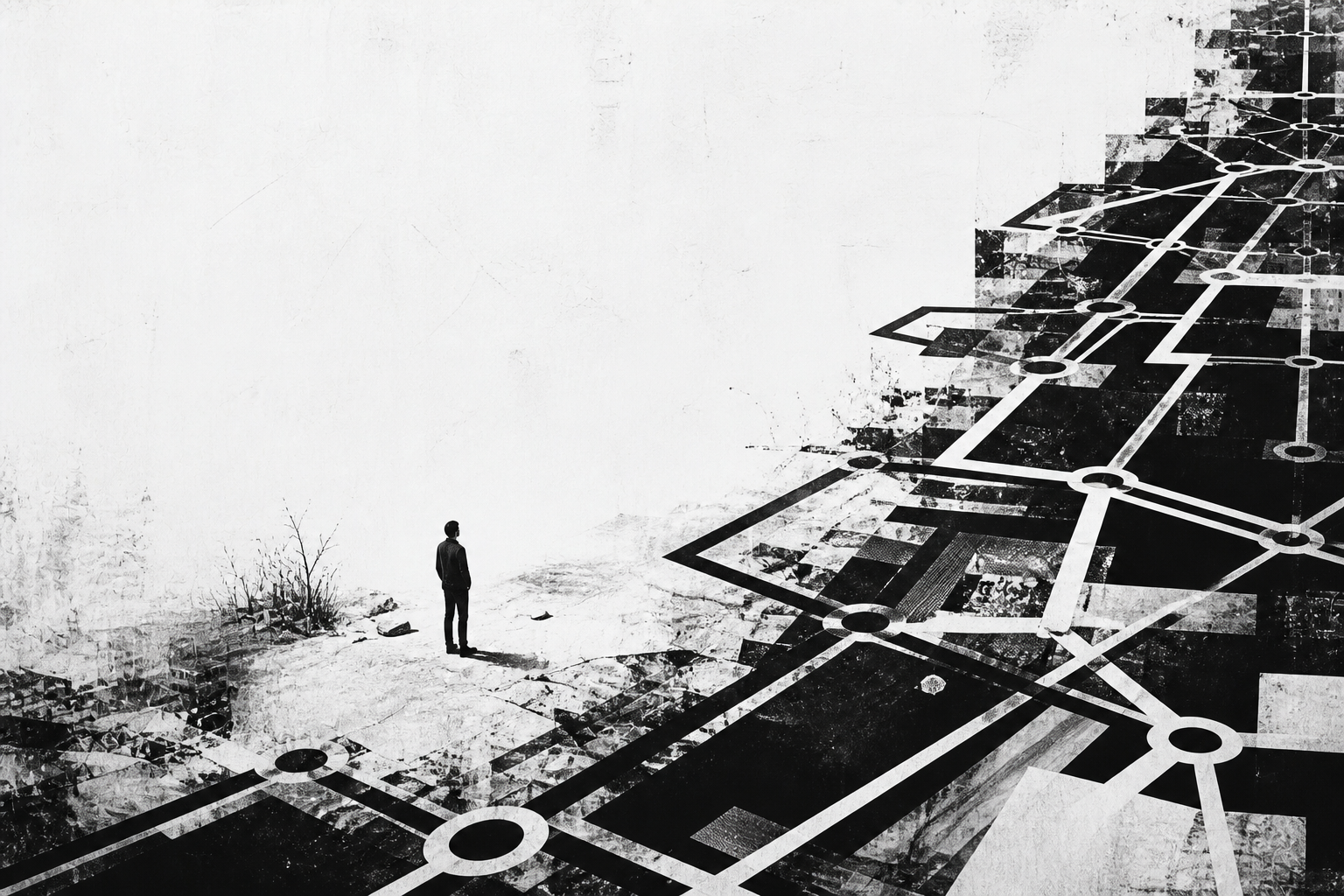
Our journeys always have a destination.
From the station to the hotel. From the hotel to a tourist attraction. From wherever we are to the 4.5-star restaurant we found online. Open a map, and it gives us the shortest route and an estimated arrival time. If we get there without getting lost, without stopping, and exactly as planned, the journey is a success.
But how much do we remember about what we passed along the way?
Travel undertaken solely to reach a destination has become pervasive. Time spent in transit is treated as a cost to be minimized, while the scenery along the way becomes noise to be filtered out. The more convenient the world becomes, the more it is divided into “places worth going” and everywhere else.
This is not only a story about maps.
For at least the past century, our societies have moved toward freeing people from all kinds of constraints.
We have learned to obtain more things, more cheaply and more quickly. Ways of living once available only to royalty and the wealthy have become accessible to the public. More people can travel to distant places, encounter knowledge from around the world, and choose how they want to live.
This transformation has been driven by rationality and convenience. Google and Amazon represent two of its clearest achievements.
Google’s search box is close to the ultimate interface for accessing information.
Put what you want to know into words, and useful results appear almost instantly from an immense body of information. From PageRank to generative AI, technology has continued to shorten the distance between wanting to know and knowing. How many people today would go first to a bookstore or library when they need to look something up?
Access to information is now an almost-solved problem.
Amazon is similar. It deals with physical objects rather than information, but the question it solves is much the same: how quickly and effortlessly can people receive what they want? Search, compare, click a button—and it arrives the next day.
Google optimized our arrival at information. Amazon optimized our arrival at objects. Maps optimized our arrival at places.
What they gave us was freedom of choice and freedom through efficiency. More possibilities now stand before us than at any previous point in history.
That freedom is unquestionably something humanity has achieved.
But having more choices is not the same as being able to choose.
Do we really know what we want? Were human beings ever particularly good at deciding where to go entirely by themselves?
For much of history, people spoke of religion and fate. They followed the customs of their communities, shaped their lives around the seasons, and understood their place in the world through stories rooted in the land.
These things could constrain individual freedom. But they also created a condition in which people did not have to choose, decide, and explain everything by themselves.
A chance event could be received as guidance. An unexpected encounter could be called fate. A person could feel summoned by something beyond themselves.
Perhaps these were ways for people—who could never decide everything alone—to form a relationship with the world.
A rational and liberal society removed many of those old constraints. In exchange, it made the individual responsible for answering a new set of questions: Where will you go? What will you obtain? What kind of life will you live?
The range of possible choices was maximized. But the responsibility for choosing was concentrated in the individual.
The defining constraint of our time may not be a lack of options.
Because we are free from constraint, we must continually decide where to go. Because we can go almost anywhere, we must keep answering the question of where we should go.
It is the constraint of having no constraints.
We have spent a long time developing technologies that take us wherever we want to go.
But we have thought far less about how to encounter the world when we do not know where we are going.
In an age when we can go almost anywhere, can we still form a relationship with the world without first choosing a destination?