timespace works on one simple loop: point a phone at a place, and an AI reads it — its history, its mood, whatever happens to be sitting in the air right now — and turns it into a short piece of writing. Do that enough times in one city, and the pieces add up into something close to a living magazine of that place, edited by hand every day and printed as a paper zine.
For five days in September 2026, we ran that loop live at Ars Electronica in Linz. Every morning we scanned the city. Every afternoon we edited what came back. Every evening, a new issue went out onto the street.
Somewhere in the middle of that, a different kind of project started, without anyone planning it.
Three encounters in Linz
Ars Electronica doesn't only draw people who already have their answers. Artists, teachers, researchers, students, designers, people running public programs, city officials, people trying to change something in a city through art or design — each of them was looking for something, and each could only find it through one specific, unrepeatable encounter.
We were no different.
So every time a conversation went deep enough, we asked it again.
"Where should timespace go next?"
What was interesting was never the city name itself. It was the pause right before it — the moment we could watch someone quietly start running timespace on a place only they knew. Every time, it was a small, involuntary thing to witness.
Looking back, a city always surfaced the same way: at the exact moment someone else's history collided with ours.
KOŠICE
Košice came from a Slovak designer — someone who has spent years actually working in the field there.
She wasn't saying Košice was pretty. She was comparing it to Bratislava — talking about education, graphic design, the way a city chooses to present itself.
The culture is there. The history is there. What's missing is the muscle to translate that into how the city looks and reads today — a capital-versus-everywhere-else tension we'd already heard more than once in Linz itself.
Maybe that's exactly why Košice.
It wasn't a tourist's opinion. It was the specific temperature of someone who deals with that gap for a living. Watching the daily Linz zine, you could see timespace shift, in her head, from "an app for visitors" into something closer to a tool for a city to see itself again.
Municipal budget came up. A possible local introduction came up. A city we hadn't known about ten minutes earlier was quietly becoming an actual place to work.
ENSCHEDE
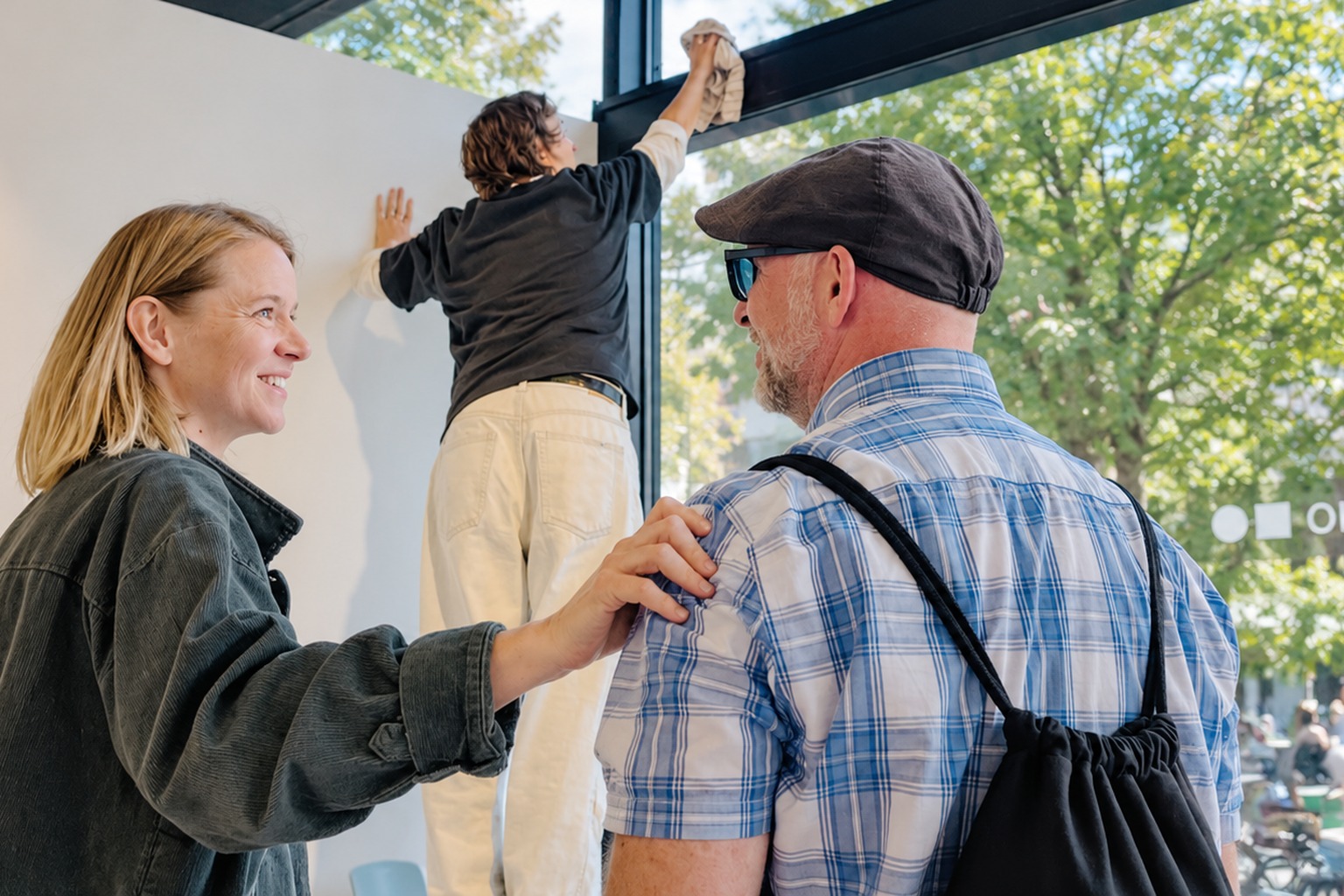
At the café by OK PLATZ, we ended up seated next to a group from the Netherlands — three teachers, three students.
Photography. Coding. Music. The conversation started off the Linz zine sitting on the table, and we showed them timespace: photograph the street, let AI read the place, out comes an article; gather enough of those, and a human edits them into a magazine.
Somewhere in the explaining, something clicked on their side.
They were from Enschede.
We learned later that one of them, Julian Enequist, teaches Sound Lab at AKI ArtEZ. AKI's Moving Image program runs across photography, film, sound, interactive media and experimental technologies, and lists Ars Electronica as a place its students go to train.
One more thing we learned afterward: AKI is the smallest art academy in the Netherlands, based in a neighborhood called Roombeek — a district rebuilt after a fireworks-factory explosion tore part of it apart. The school itself, we're told, asks one question before any technique: is this actually your own story?
And Julian doesn't live in Enschede. He's a Berlin-based music producer who runs his own label, OBSCULTURE, and releases his own music as ENEQUIST.
The city he teaches in and the city he lives in are different places.
For him, Enschede isn't home — it's somewhere he crosses into to hand something to the next generation.
Which is maybe why, the moment he saw timespace, two questions seemed to collide for him at once: what happens if students walk their own city like this? What if you scanned sound, not just photographs? What if the city itself became the studio?
We can only guess at that. But the next day, a message arrived.
"Hi Taka, this is Julian Enequist, sound / music teacher from Enschede (the next city for timespace!)"
No proposal to a university produced this. Six people who met by accident in a café saw the same thing for a few minutes, and something caught.
YEREVAN
At the same café by OK PLATZ, this time someone else started the conversation.
Andronik Khachiian and Andriesh Gandrabur — two people building programs for hosq, based in Yerevan.
And they already knew Sekai Camera.
Hearing the name of something I'd built over a decade earlier, from two people who had flown in from Yerevan, was the single most disarming moment of the whole trip.
Because they already understood AR and location-based media, we skipped the explaining and went straight to the interesting part. What they actually wanted to know wasn't what the app does.
Who is looking at the city. Who makes the raw material. Where AI's job ends. Where a human starts editing. Whose knowledge it becomes, and how it circulates from there.
We looked them up afterward, and the two of them turned out to be pointed in almost opposite directions.
Andriesh once did sound for Ice-Pick Lodge, the studio behind games like Pathologic — the kind of game that refuses to hand a player easy answers and simply makes them live inside an unsettled world. Later he founded his own music school, DOS, and built the sound art program at HSE's design school from scratch.
Andronik works the other way: bio art, performance, no fixed base — a curator who has moved between exhibitions and labs across Europe, Mexico and Armenia.
One of them understood systems that withhold answers on purpose. The other understood editing as something done by moving through places, not by staying still. Put the two of them side by side, and you could already see the shape of hosq.
hosq itself works across sound, performance, bio art and technology, pulling people from different disciplines into experimental labs and programs.
So to them, timespace was never a finished piece of media. It was a mechanism — for gathering people, observing a place, and generating something out of that.
We felt the same thing back. Somewhere in that conversation, Yerevan stopped being "a place we could scan next" and turned into something else: what happens if timespace runs inside a hosq program itself? Participants go out into the city. They observe. They bring something back. AI transforms it. A human edits it again.
That's when Yerevan, as a city, actually came into focus — for us, too.
A city appears in conversation
Košice. Enschede. Yerevan.
None of them started on a shortlist. And none of them came from someone simply telling us where to go.
A designer laid her own city's problem over ours. A teacher, caught between the city he lives in and the one he teaches in, imagined an experiment with his students. A game-sound designer and a bio artist stood next to each other, and the gap between them became the outline of a project.
And on our side, listening to each of them, we imagined — for the first time — what timespace could actually become in that place.
A city seems to arrive in the middle of a conversation.
Or more precisely: a city arrives at the exact moment two personal histories collide. Someone's long-carried discomfort with their own city. Someone else's years of practice. The moment timespace touches both as a third story, a city's image is finally born.
What we were actually looking for at Ars Electronica was probably never just the next place to hold an event.
It was this: meeting someone, somewhere in the world, who is also looking for something — and having the same image fire in both of your heads at once.
"Then why don't you try it in your city?"
That might be exactly how the next timespace City always starts.