What is a ZINE?
I imagine quite a few people would struggle to answer that question.
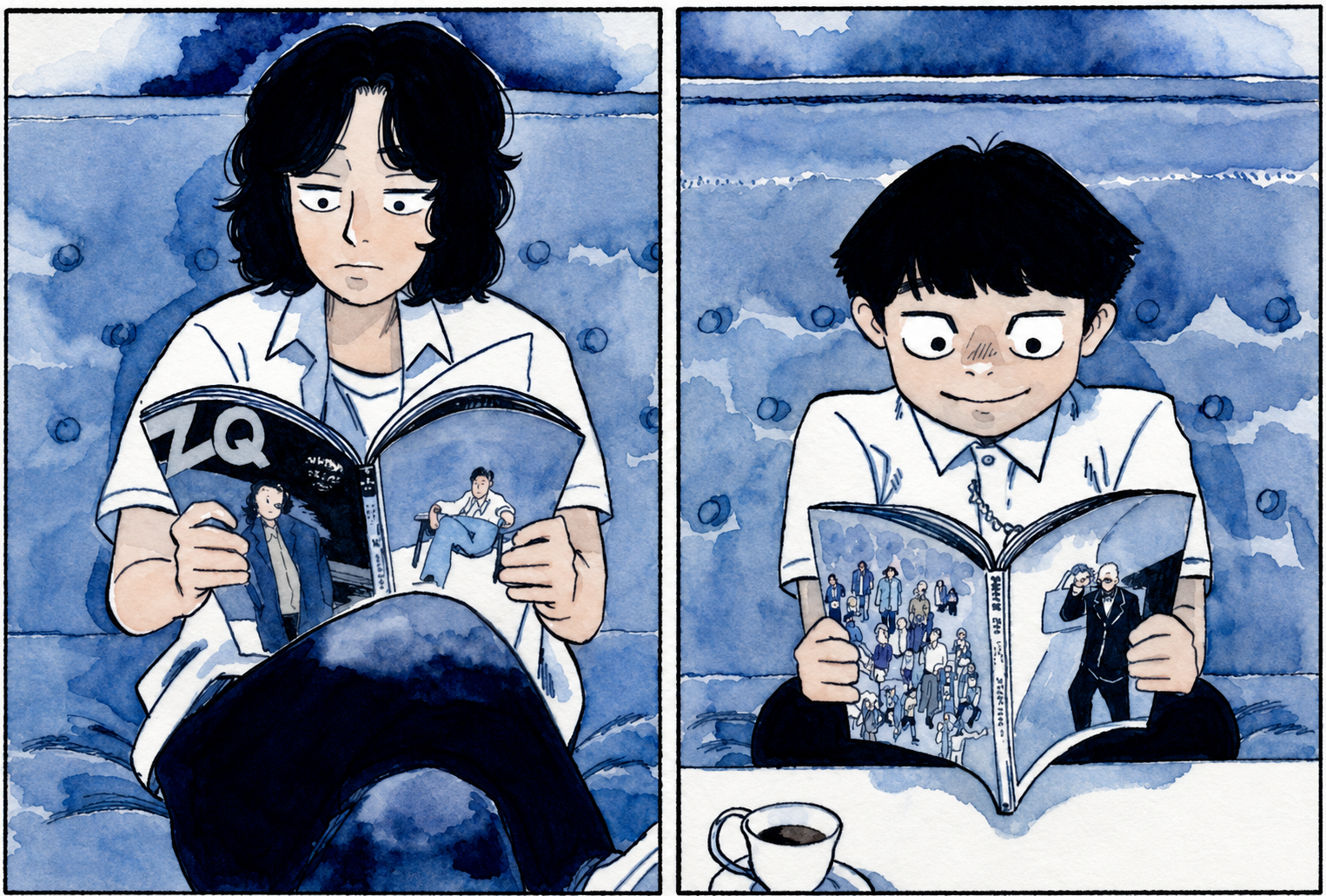
There is a manga called RIOT. It follows a group of high school students in a rural seaside town who one day decide that they want to make “something like a magazine.” The series is published in Big Comic Spirits, a mainstream Japanese manga magazine for young adults.
It is a curious setup.
ZINE-making is still a very marginal activity in Japan. Zines tend to circulate in the corners of bookstores, at small events, and within relatively limited communities. And yet someone has deliberately chosen this peripheral practice as the central subject of a manga and placed it on the completely different stage of a major commercial magazine.
Japanese manga really does go surprisingly deep.
That tension was what first caught my attention.
The creator of RIOT, Yuta Tsukuda, also works outside the manga world as the designer and illustrator of an actual independent magazine called BEACON.
BEACON describes itself as a “survival report magazine.” Its first issue appeared in 2021, during the COVID-19 pandemic, beginning with people in different parts of the world sending in reports about their everyday lives as a way of saying: I’m still here.
Essays, criticism, manga, interviews, art. Fragments that refuse to fit neatly into categories are gathered together into a single bundle of paper.
So this is not simply a story confined to fiction.
While the high school students inside the manga are trying to make “a magazine of their own,” the creator himself is continuing to make an actual magazine in the real world. The impulse inside the fiction and the practice of DIY publishing outside it exist on the same continuum.
That is part of what makes it so interesting.
And yet the title RIOT may give you pause.
ZINE culture has many lineages: punk, science-fiction fandom, comics, queer culture, feminism, art, and more. Among them, the tradition of self-publishing as a means of resistance and speaking out—Riot Grrrl being one of its most visible examples—feels particularly powerful.
At least for me, the word RIOT immediately brought that countercultural lineage to mind.
But the manga itself is something entirely different.
These high school students have no grand desire to change the world. They simply want to make “something like a culture magazine.” That is all. There is only the initial impulse to make something.
The same is true of BEACON and its idea of the “survival report.” It is not a declaration addressed to the world.
It is merely the smallest possible proof:
I am here.
There is something minimalist about it, almost a sense of knowing what is enough.
In that respect, it feels closer to bonsai, dry landscape gardens, Zen painting, the tea room, or the seventeen syllables of a haiku: ways of compressing an enormous world into a finite form.
The point is not to change the world, but to fold it down into something smaller and place it back within reach.
A ZINE, then, is not necessarily a tool for making one’s voice louder.
It can be a practice of keeping the voice small while endlessly increasing its precision.
And today, this “technology of making things smaller” suddenly feels strangely contemporary.
On one side, we have the battle of enormous capital surrounding AGI: a trajectory aimed at capturing the world in its entirety.
On the other side are the high school students in RIOT, and people like Tsukuda continuing to make BEACON: a far more personal and local form of world-building.
A kind of miniature garden.
They are not trying to change the world. They are simply taking it back into their hands at a scale small enough to hold.
Compared with AGI, it can look almost absurdly small.
But perhaps, in places invisible to those competing to capture the entire world, a completely different way of making worlds has already begun.